
A Gannet’s Eye
Before the journey.
Friends,
My project at St David’s Head has now officially begun and as you read this I will probably be sitting on a cliff in the wind and rain. If the weather gods are kind it will be dry, overcast, but at least 10 degrees colder than the rest of the UK . . .
In the past few years, I’ve been racking my brains about the best way to progress my work. Places are my passion, and how we connect to them in deep ways. I could have written a book about this, but I have to confess that writing long-form is not really my thing these days. I have no plans to write another trade book (though an artist’s book will come out of this project —more about this soon).
What I want to do now is create experiences rather than just stories. I want to combine my paintings, texts and films to create those experiences.
Down the line there will be an exhibition and, hopefully, it will tour. I’m talking to galleries at the moment, and also to cathedrals and churches — all beautiful spaces in which to show the work.
I’m not sure if the term “thin place” is an old one. I first heard it when my friend Kerri ní Dochartaigh published her memoir of that name a couple of years ago. A thin place is a liminal place, somewhere where the edges of worlds meet.
This is literally so at St David’s Head. It’s an edgeland shaped by the interplay of natural forces and human presence.
Strange how patterns and themes, or obsessions, appear and reappear over time. I had forgotten that my book, Two Lights, ends with an imagined scene that travels from St David’s Head, over the sea to the islands, at last reaching “a molar of rock, paler than the sky”.
The rock is Grassholm, a place I’ve never visited, and have only ever seen from the mainland. It does indeed look like a tooth, spattered with gannet guano.
I love to watch gannets fishing, usually at a distance, too far away to see their amazing jewel-like eyes. If the weather is good (surely there will be periods of calm in a four-month stretch!) I’ll go out there by boat and see them close up. When I do, I’ll take as many photographs as I can and share them with you.
This week, though, I’ll be on the headland, trying to familiarise myself with the place. I’ll begin with a short pilgrimage.
St David’s is historically an important place of pilgrimage. In the Middle Ages, two pilgrimages there were declared by Pope Callixtus II to be the equivalent of one to Rome.
I don’t have the stamina to walk hundreds of miles, so I’ll begin at St Non’s Chapel. St Non was the mother of St David and legend says she gave birth to him on a headland during a great storm, on the spot where the chapel and holy well now stand.
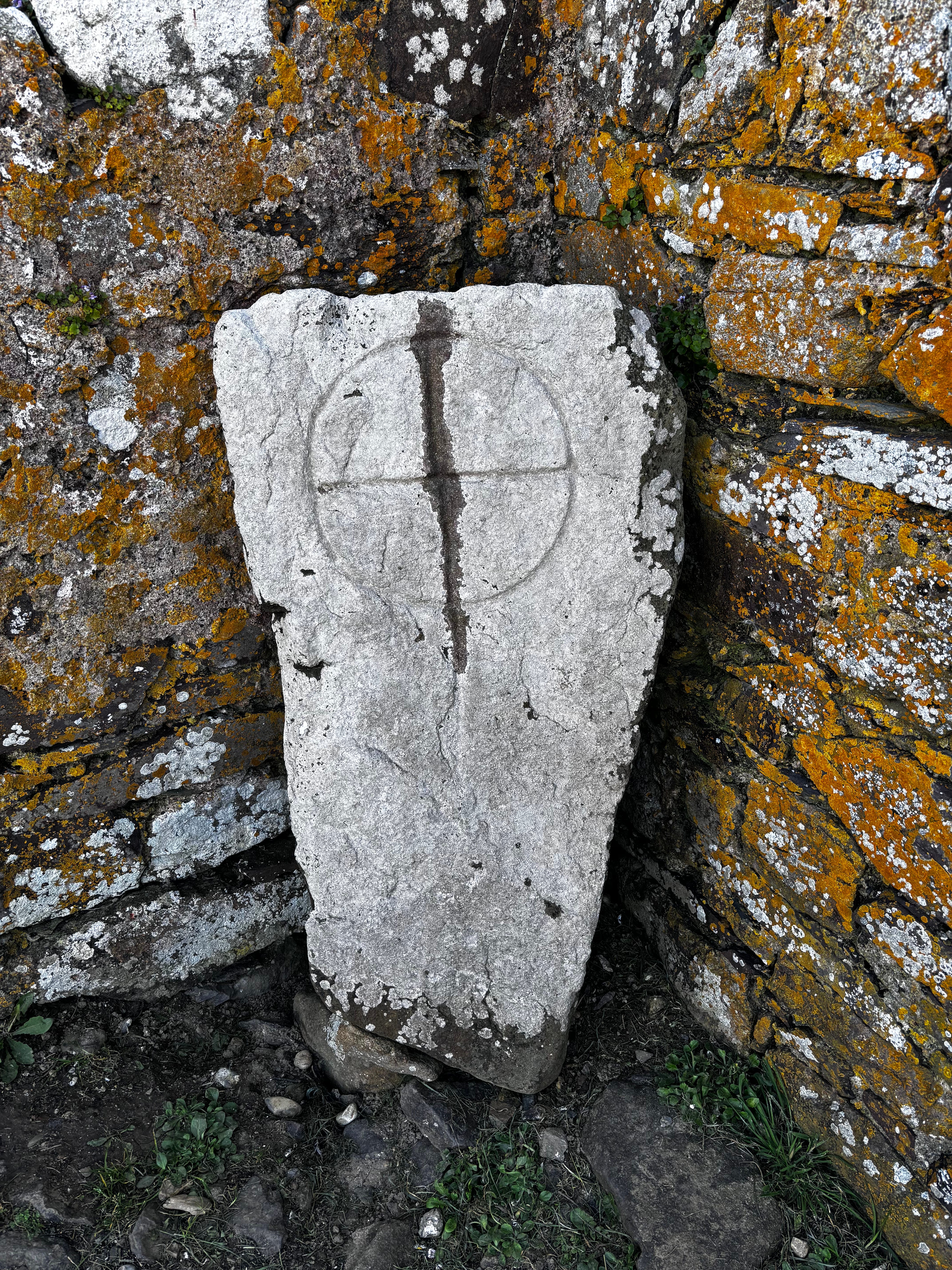
It’s a beautiful ruin housing a simply inscribed Celtic cross on an upright stone, situated metres from the cliff edge south of the little city.
This feels like the right way to begin: to approach the place slowly and with reverence, asking permission before I start.
I’ll let you know how it goes and include the first pictures next week. Until then, below is that final section from Two Lights.
Thanks for reading,
J
“At the far western tip of the bay the last tooth of the upland reaches out towards the sea. A ridge, shaped like the back of a giant lizard, perches at St David’s Head, overlooking a three-toed peninsula, the most westerly point in Wales, our finis terrae. Above the hill are the wheeling shapes of herring gulls, greater and lesser black backs, more than a hundred of them, silhouetted against a sky which is beginning to blend with the sea. Their harsh calls mix with the hiss of wind and waves. Among the piled rocks there are signs of old settlements, a burial chamber, enclosure walls, the remains of house platforms. For thousands of years we have occupied these isles to their very edges.
A few miles south Skomer is a sprawl of ancient field walls, hill forts, chambered tombs. On its north side is a scar in the cliff where a ramp was cut to transport livestock on to the island centuries ago, sheep and cattle made to swim across the sound from the mainland. Its abandoned fields are now a warren covered with a million bluebells. We have withdrawn, but only a fraction. Though the island is no longer farmed it is still under our control, a place for tourism and research. We monitor the resident and migrant species, counting their numbers, observing their declines, making and revising best guesses about causes.
There is only the faintest glow in the west. Colours are gone. Against the horizon one shape is just visible, a molar of rock, paler than the sky, as if a weak lamp lights it. Across the water another pale shape is moving, faint enough to be an afterglow. The bird is flying west, its wings beating fast, as if it were trying to catch up with the light. The sulphur yellow of its head and neck feathers is not visible and the black tips of its wings have disappeared. It could be a gull, a tern, a swan or the ghost of a bird. The gannet is heading to the little rock far out at sea where thousands of its kind are sitting on eggs or warming newly hatched chicks. For the coming months the island will be alive with their calls, with their whiteness and stink, the colony like a single organism spread across the rock. The last light of dusk will fade away in a gannet’s wild eye.”