Twisted Branches
Towards a tangled aesthetic.
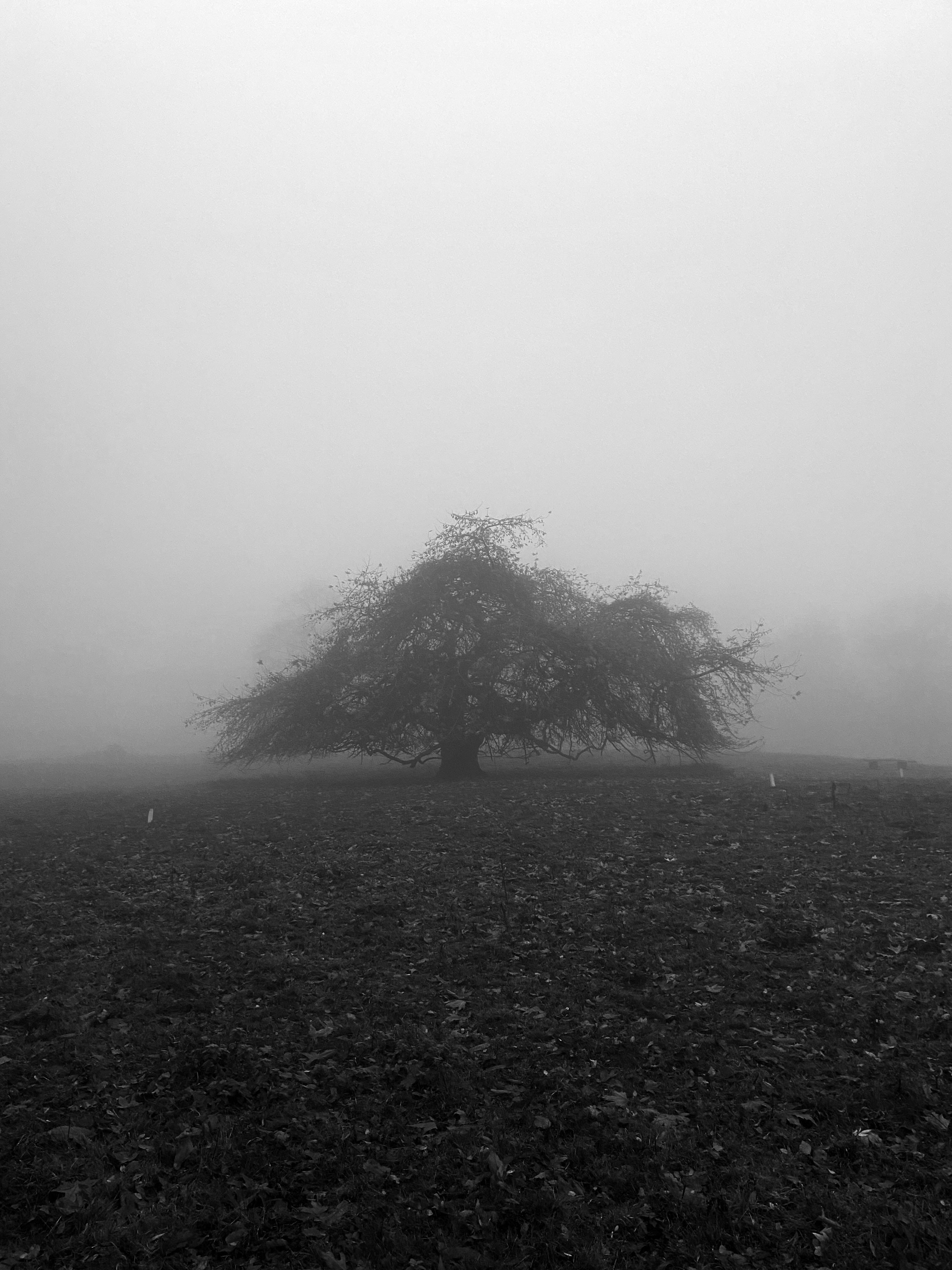
Beautiful isn’t it? It’s a Persian Plane tree in the fields surrounding Hergest Croft garden, a short walk from my house. The tree has a remarkable shape, like a flattened teepee, its branches fanning out and pointing down to the ground. Stoop low under those branches and you can walk into the space surrounding the trunk, which is also tent-like. I took this shot around a year ago, as the tree was losing the last of its leaves, on a day of thick mist. I think the photograph is one of the best I’ve taken. Mist is an opportunity to create with negative space. What you can’t see in the picture is all the other trees, hundreds of them, only a short distance away. You can just make out the outline of an ancient oak to the left, a tree in its time of decline, with a little cave in its trunk that you could shelter or sleep in. There are so many incredible trees here. Just beyond the field is a steep decline which leads to a wood so beautifully planted you can almost hear the faeries singing when you’re inside it. But it’s much harder to take good pictures there, because the space is closed in, shaded, densely woven with life. Good photographs often require absence to outweigh presence. Woods rarely provide such spaces.
Aesthetic sensibilities change rapidly over time. Look at any photograph from 10, 20, 30, or 40 years ago and you can see the transformation. It’s not progress. Lately we’ve become obsessed with a minimalist aesthetic. Many homes are now styled like hotel rooms, bare and austere. The aim seems to be to make rooms look as if nobody has ever been in them. In the centre of the usually white space sits a centrepiece, a fine sofa, or table, or work of art, usually a field of subdued colour or tone. This aesthetic communicates to me the opposite of what it’s declared to be. It’s not about simplicity or paring back the consumer urge. It’s about newness, acquisition, the excitement of the untouched object just acquired. We live in display cases now, an aesthetic of emptiness.
Behind our house, only a few metres away, is a huge copper beech tree. The branches tower over the house and touch the roof in places. At this time of year it sheds leaves in their tens of thousands. The gutters fill and choke. Our tiny yard is carpeted every morning with burgundy. The tree is fully mature, at its peak, a fine example of one of the most beautiful of all tree species. It grows on the edge of a piece of disused ground, littered with waste. Around its silver trunk are piles of shattered glass, beer cans, old fences, mattresses, roofing materials. A year ago I had to call the police because someone had dumped a suitcase full of dead animals beneath it. It is not a venerated tree. My neighbours view it as a nuisance, a threat to their properties. One of them calls it the bane of her life. It’s a tree which is hard to take pictures of, growing so close to our houses. You can’t get far enough back from it to see its shape, you can’t frame it or position it with enough space around it. I’ve never seen anyone taking a picture of it except to send to the landowner or the council demanding it be chopped down, which I’m sure it will be some day. It’s one of the most beautiful trees I’ve ever known, but it’s a loner, and no tree should ever be alone.
News of the illegal felling of a famous tree in the UK, known as Sycamore Gap, spread across the world last week. I’d never heard of it. I don’t want to dwell on the criminal act. So many words have already been written about it, millions I’m sure, an outpouring, not so much of grief - though people certainly felt that - but of opinions, the currency of our culture. Imagine all those words (and here are a few more) gathered together, printed out and laid on the floor. They’d cover hundreds of acres and require the cutting down of a whole forest. It’s a phenomena that repeats all the time when something outrageous occurs. Words burst out of us uncontrolled and take on unintended shapes. They can become as twisted as old trees, as forbidding as a wildwood. Good words, like poems, require silence and space.
As part of the outpouring the Guardian newspaper published a series of pictures of Sycamore Gap: snow-scenes, spring-scenes, time lapses of the tree backgrounded by the Milky Way and the Northern Lights. Instagram stuff. The picture I came back to is the drone shot below. The sycamore takes up so little space in this picture you could almost miss it. What you see is an almost white-out with a single dark line crossing it, like a stroke of calligraphy. You see the shape of Hadrian’s Wall, the rectangle of the derelict barracks, and the tree as a small, dark fingerprint on the left. There are no other trees in the shot. This is not a photograph for people who love trees, it’s for those who love the aesthetic of faux minimalism. If the place was stewarded by people who love trees this photograph would not be possible, the sycamore would be surrounded by thousands of companion trees, and the image would be crowded and indistinct.
I’ve only ever been to a couple of places with to-the-horizon views of trees. One was flat, the other mountainous; one tropical, the other temperate. I didn’t take pictures of either. I remember both places vividly. What I remember is their presence, their life force. Beneath their canopies was a mystery, like the mystery of the universe, impossible to fathom but an endless source with which to imagine. In one of those places, a forested valley in the Canadian Rockies, I was followed up to the lookout point by a troop of fellow tourists. One by one they stood next to me, pointed a camera or phone, then took the shortest route back to their cars. What would I have got from a photograph of such a place? Beneath the canopy were wolves, grizzly bears, moose, beavers, wolverines, great horned owls, nighthawks, their lives and stories deeply entangled with the forest. All that richness obliterated, shrunk to a square of coloured light.
A few years ago, after a big storm, a double-trunked oak tree came down in a tiny wood I’ve walked in for two decades. I felt genuine grief seeing the toppled tree and expressed this, perhaps foolishly, on Twitter. I was quickly reprimanded and told that this was a natural occurrence, that the fallen tree would provide a habitat for new growth and would possibly regrow itself. It didn't make me feel any better, because the reprimanders didn’t factor in our culture’s obsession with management and tidiness. The tree did indeed begin to regrow the following spring, but that didn’t stop a local farmer from cutting it up and selling the oak as lumber, using the waste wood for his log burner. There’s not too much difference, I feel, between the farmer’s act of clearing, the vandalism at Sycamore Gap, and the much-requested act of vandalism on the beloved beech tree which grows over my house. They come from our self obsession, our utter belief in the me first principle. Trees are communal. We should feel as sad in the presence of a lone tree as we do for the elderly and friendless in our own communities. When we see a lone tree our reaction should not be to fell it or to photograph it, but to let it colonise the ground it grows from, to create its own community.
I have a proposal, something I think will do us all much good. Let’s create a tangled aesthetic. Let’s rid our empty spaces of their vacuousness and fill them with shapes and shadows. It will be a new kind of homemaking, welcoming back the densely woven wild, into and around our homes, and onto our hills. Let’s cultivate an earthed authenticity, living alongside other species. There’s magic in this, an act of resistance, a source of strength, courage and the mystery we need to enrich our lives. Let the oak, the beech and the sycamore grow back.
Found Things - recommendations of the week
I’ve recently read The Pine Barrens, by John McPhee. It was republished here in the UK a few years ago in a beautiful paperback edition by Daunt Books and I can’t recommend it highly enough. McPhee’s writing is wide-ranging and detailed. He writes about the geology and topography of this unique forest landscape in New Jersey, its colonial history, and its strange and wonderful folklore as well as giving vivid portraits of its inhabitants. The book was first published back in 1968, but it is very relevant now, in this age of threatened and fragile ecosystems. Since the publication of the book the Pine Barrens area has been designated a National Reserve and a UN World Biosphere Reserve, so the forest remains intact, despite threats of building airports and urban expansion from the surrounding cities at the time of the book’s publication.
Thank you for reading. Until next week, J


My goodness you are beautiful writer. Summoning tears and courage, words and image. Thank-you for sharing your great gift of observation and eloquence. It is stirring. Love making. Drawing us into stillness and quietude. Magic. Merci.
I agree- no tree should grow aline. They are greatly interconnected. https://www.smithsonianmag.com/science-nature/the-whispering-trees-180968084/#:~:text=Trees%20share%20water%20and%20nutrients,Scientists%20call%20these%20mycorrhizal%20networks.